
The names are nearly identical, the slabs can look remarkably similar across a showroom floor, and the price ranges overlap. It’s no surprise this is the question that comes up most often once a kitchen or bath project reaches the countertop stage.
The short version: quartzite is a natural stone, quarried and cut from the earth. Quartz is engineered — natural quartz crystals bound with resin and pigment, manufactured into slabs of consistent size and pattern. Both belong firmly in the luxury category, and both can be beautiful choices.
They simply behave differently. In practice, the better fit usually depends less on the material than on how a household actually uses its kitchen — how often someone cooks, how much variation feels exciting rather than unsettling, and whether an annual maintenance task registers as a minor errand or a genuine annoyance.
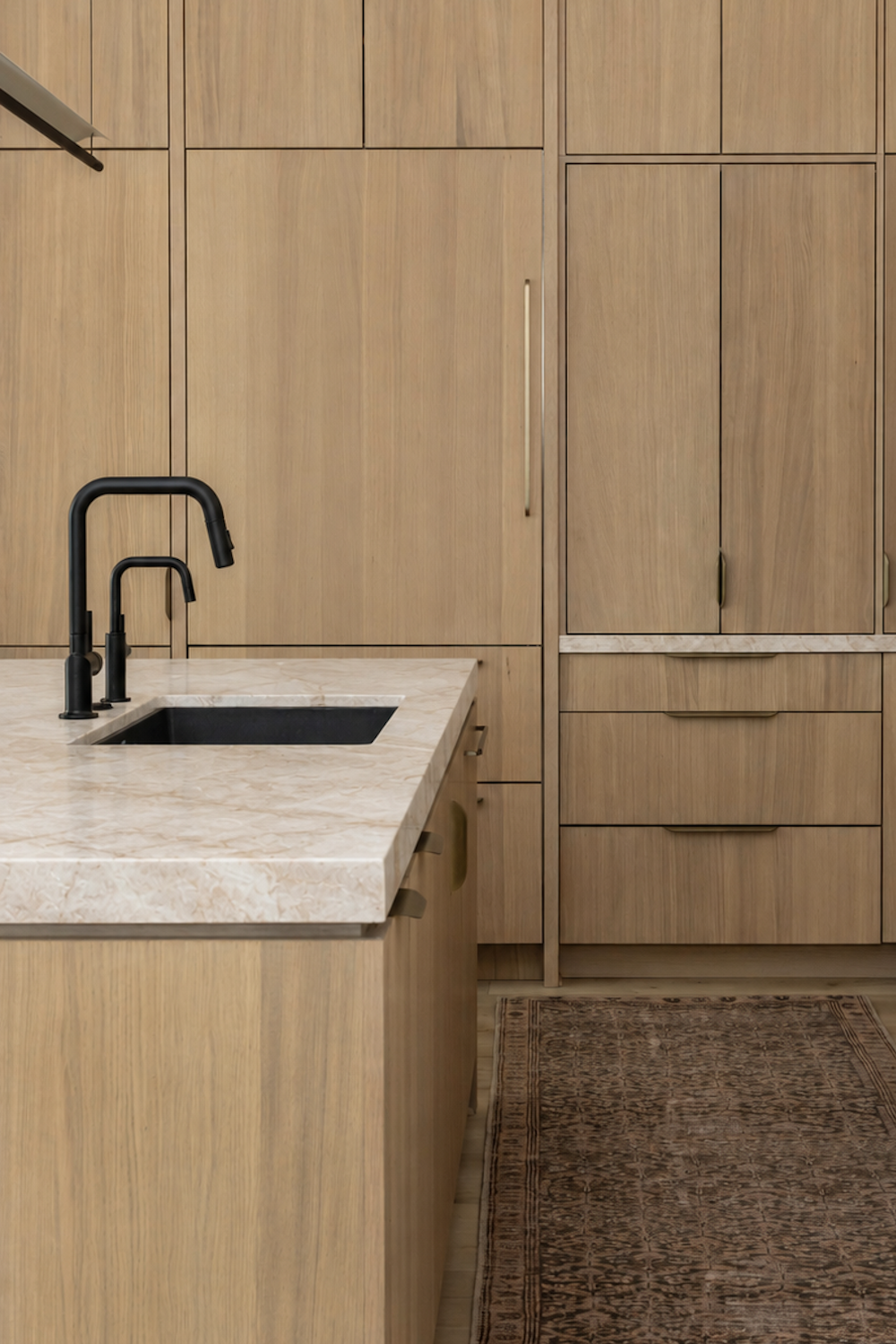
Taj Mahal Supreme Luxury Polished Quartzite Slab In Beige Virginia Kitchen
Quartzite Countertops | ID# 26050735
Warm cream with soft honey movement — forgiving to design around, and warm without overpowering the cabinetry.
THINKING FOR RENOVATION?
What Quartzite Actually Is
Quartzite begins as sandstone. Over long spans of geologic time, heat and pressure fuse the grains into something considerably harder — hard enough to resist scratching better than most natural stones used on countertops.
Visually it tends to read like marble: luminous, with a sense of depth beneath the surface and a faint translucence at the edges. What it doesn’t share is marble’s softness.
Its defining quality is that every slab is unique. That’s the appeal for many homeowners, and it makes selection a different sort of process — you’re choosing a specific piece of stone, not a product code.
Bianco Superiore Polished Quartzite
Quartzite Countertops | ID# 26050736
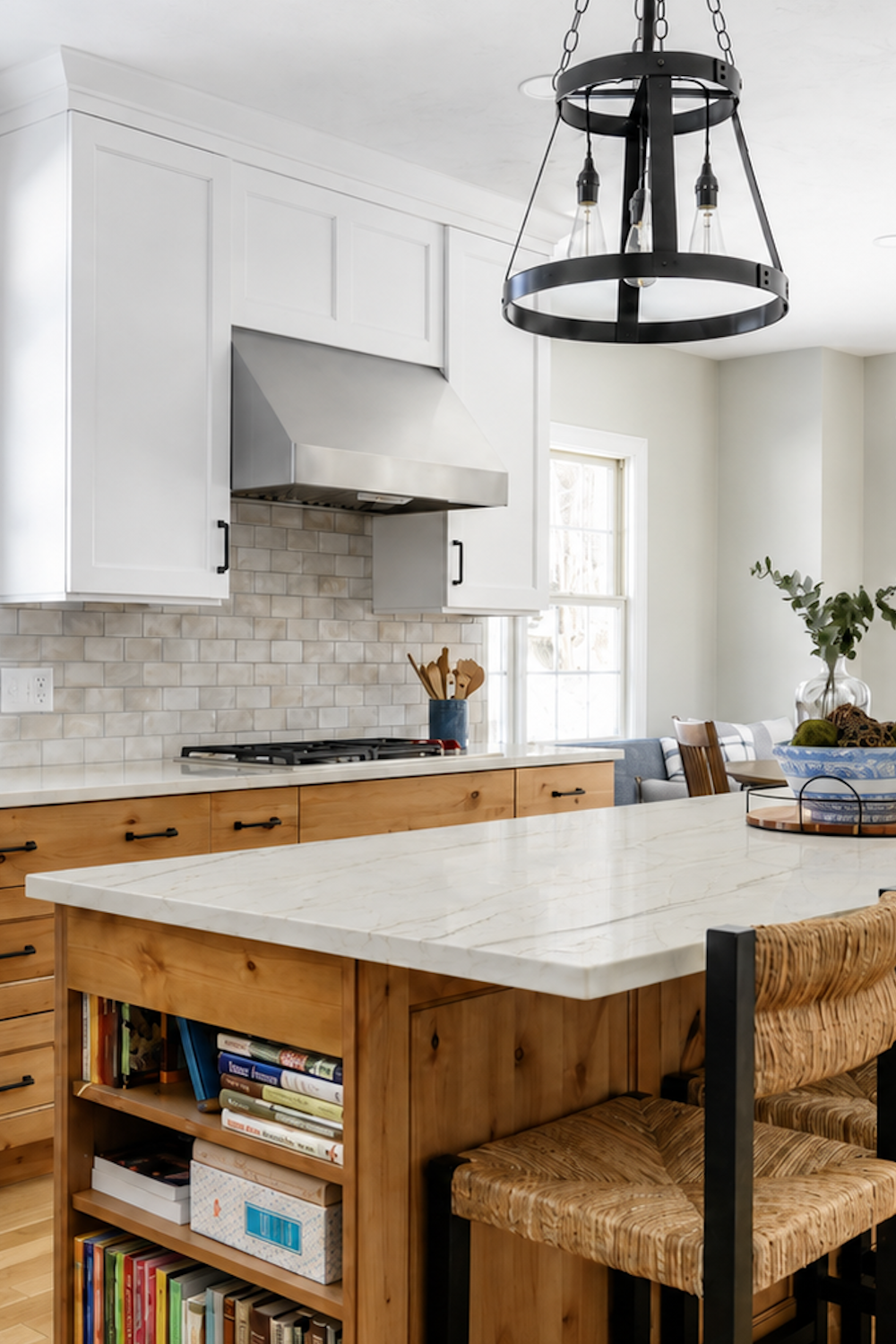
Bianco Superiore Polished Quartzite Kitchen Countertop
Bright white with restrained gold-grey threading. A quieter slab for kitchens where the cabinetry already carries the interest.
Statuario Polished Quartzite
Quartzite Countertops | ID# 26081137
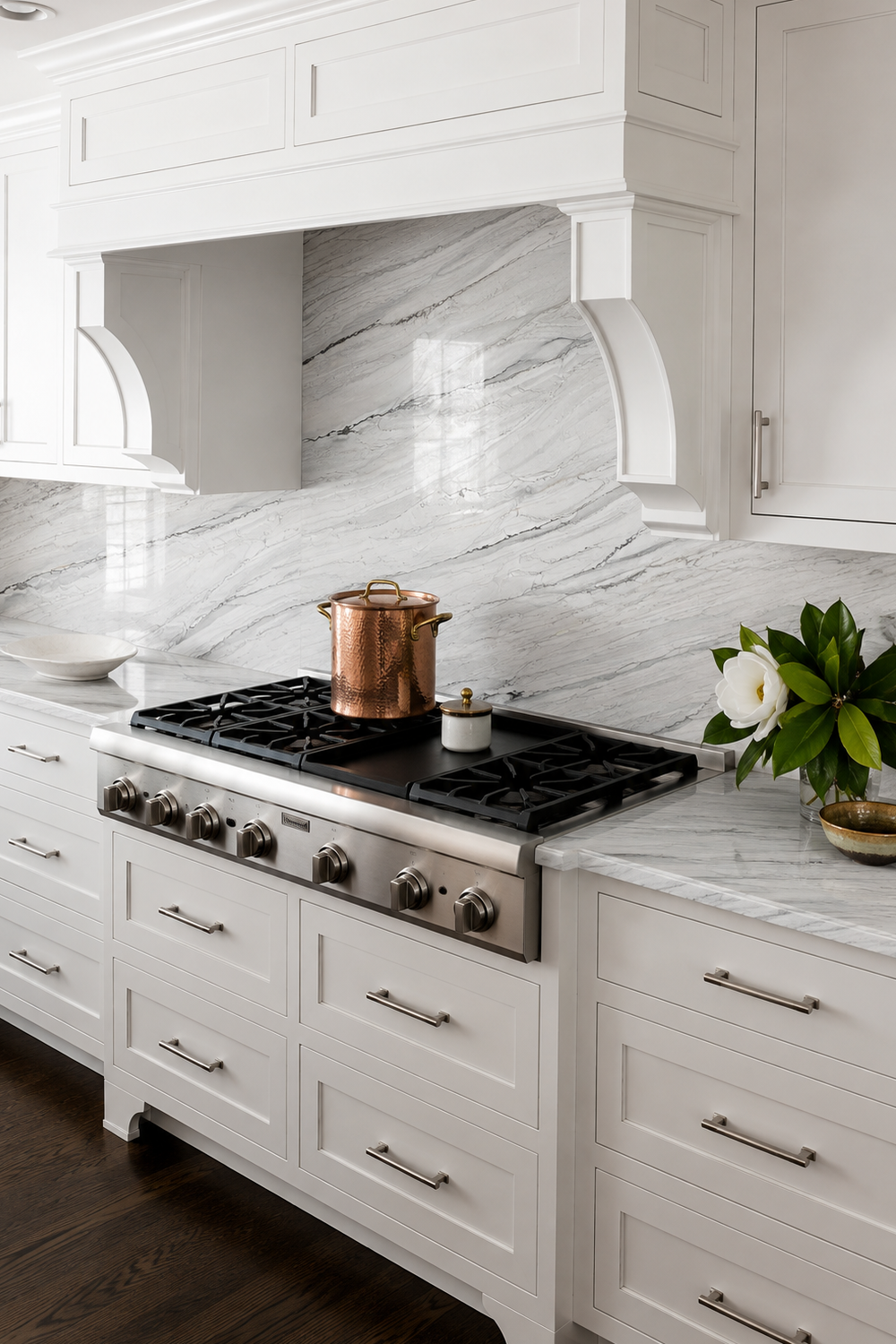
Statuario Polished Quartzite Kitchen Countertops & Backsplash
Confident diagonal veining, carried floor-to-hood. Running the slab up the wall also removes grout from the hardest-working surface in the room.
The Range Is Wider Than Most People Expect
Homeowners often arrive picturing quartzite as a white, marble-adjacent stone. The category covers considerably more ground than that — from near-neutral whites to deep, saturated statement slabs.
Our Luxury Quartzite Collection
From the blue-grey drama of Explosion Blue to the warm cream of Taj Mahal Supreme — hand-selected slabs for kitchens, baths, and statement islands that we have in stock at our Sterling location.
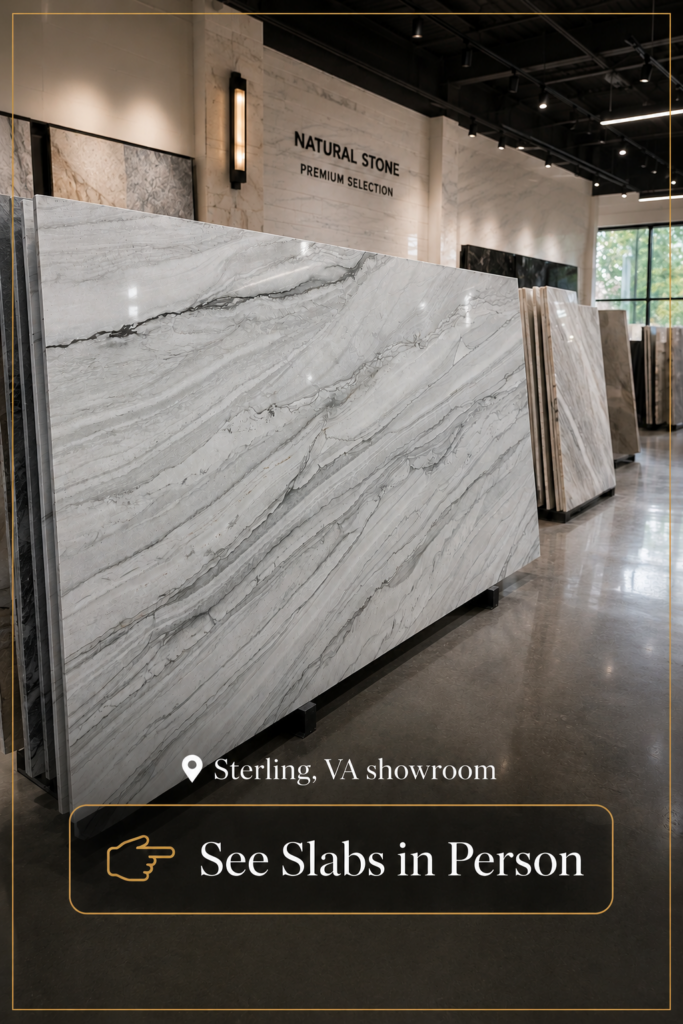
Quartzite Slabs at the Sky Marble and Granite Showroom in Sterling, VA
Full quartzite slabs on display at the Sky Marble and Granite showroom in Sterling, VA — compare natural stone in person for your DC, Maryland & Northern Virginia project.
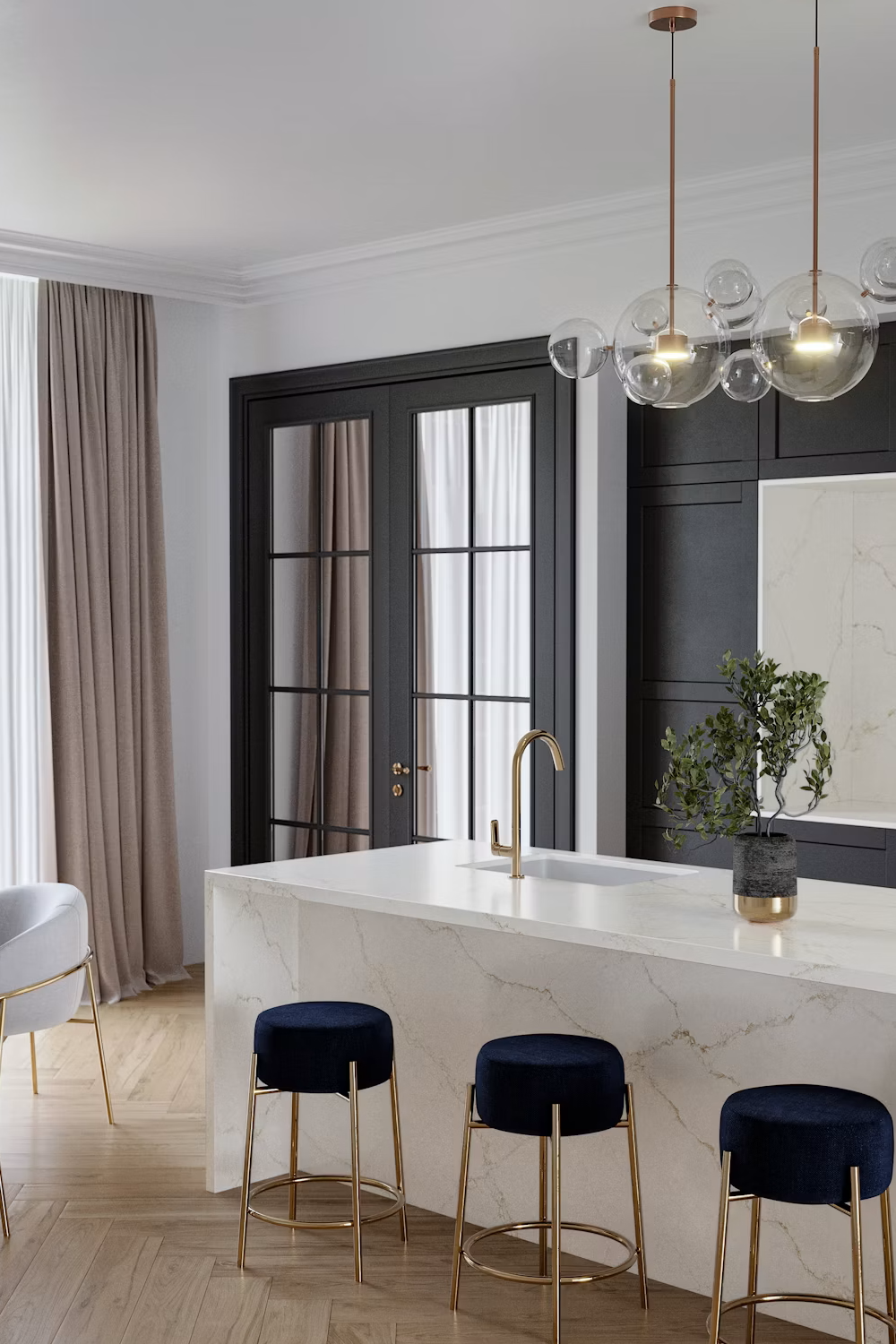
Le Blanc Polished Quartzite
Quartzite Countertops | ID# 26050739
Le Blanc Polished Quartzite Waterfall Kitchen Island
A clean white field with fine gold-grey threading. Restrained enough to keep a waterfall island reading as one volume.
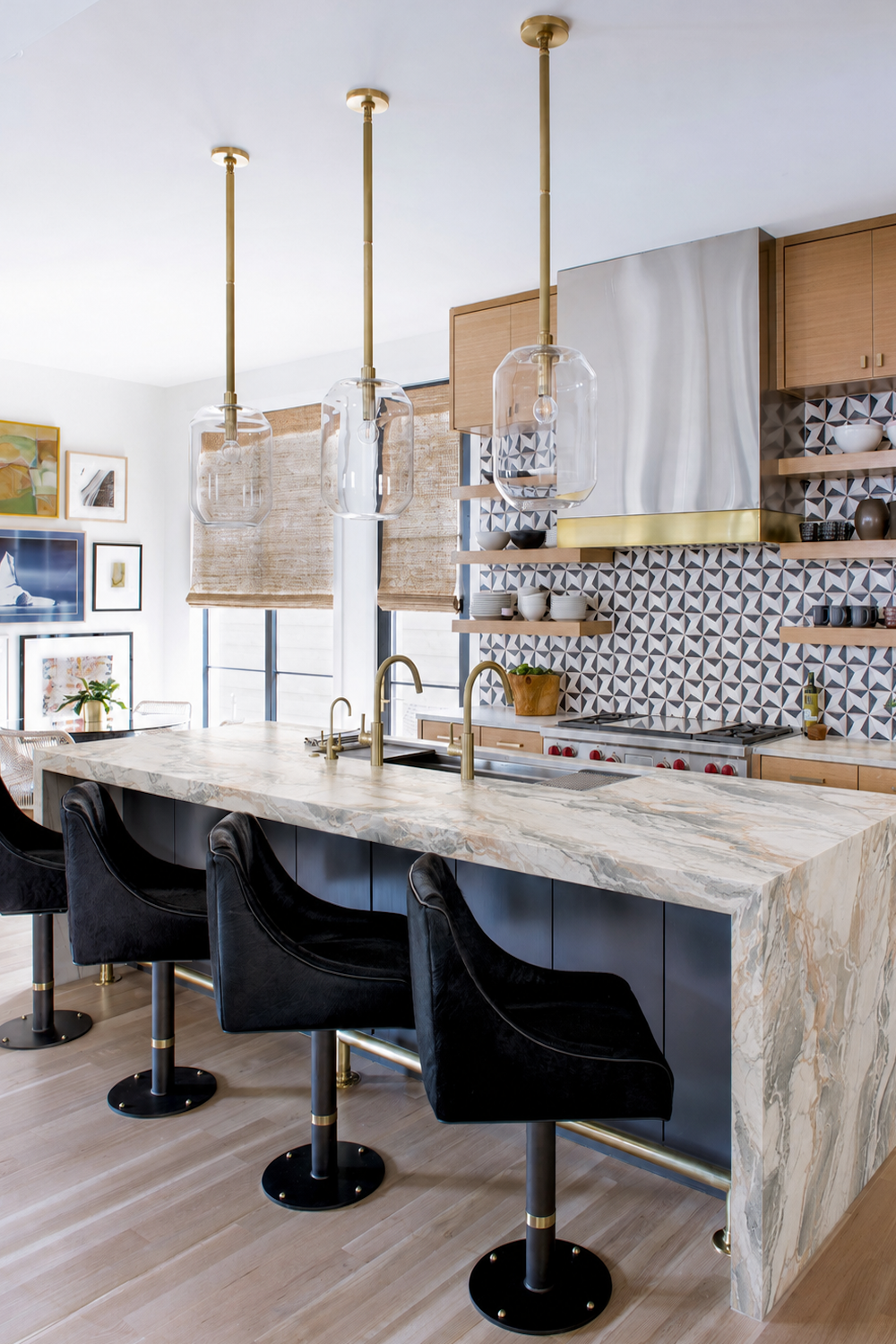
Dolce Vita Polished Quartzite
Quartzite Countertops | ID# 26050726
Dolce Vita Polished Quartzite Waterfall Kitchen Island
Sweeping cream and grey movement wrapped over a waterfall edge. Stones with this much motion reward a simple backsplash.
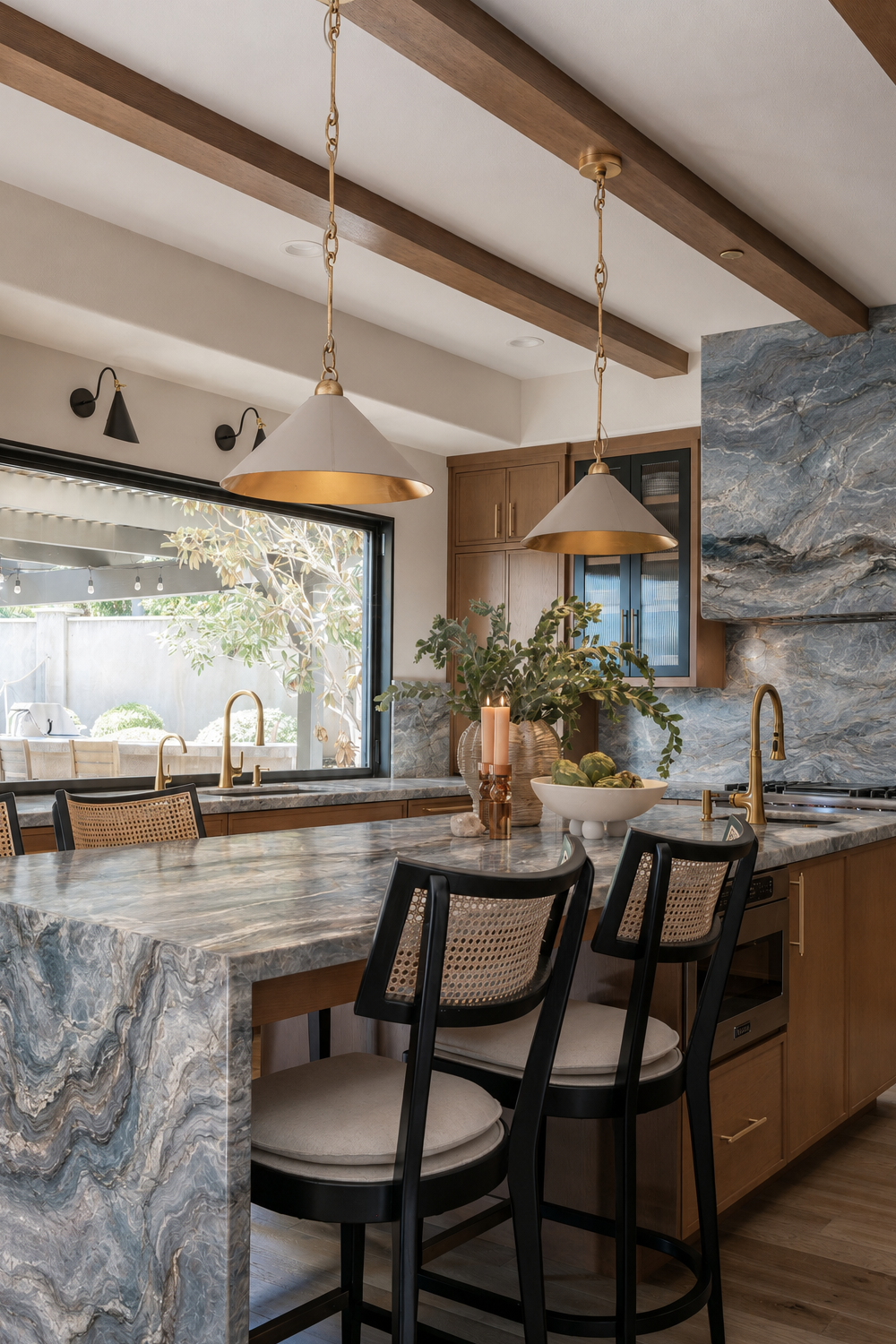
Explosion Blue Polished Quartzite
Quartzite Countertops | ID# 26050728
Explosion Blue Polished Quartzite Waterfall Kitchen Island
Blue-grey currents through a warm field. A statement slab, often at its best in a bar or pantry room.
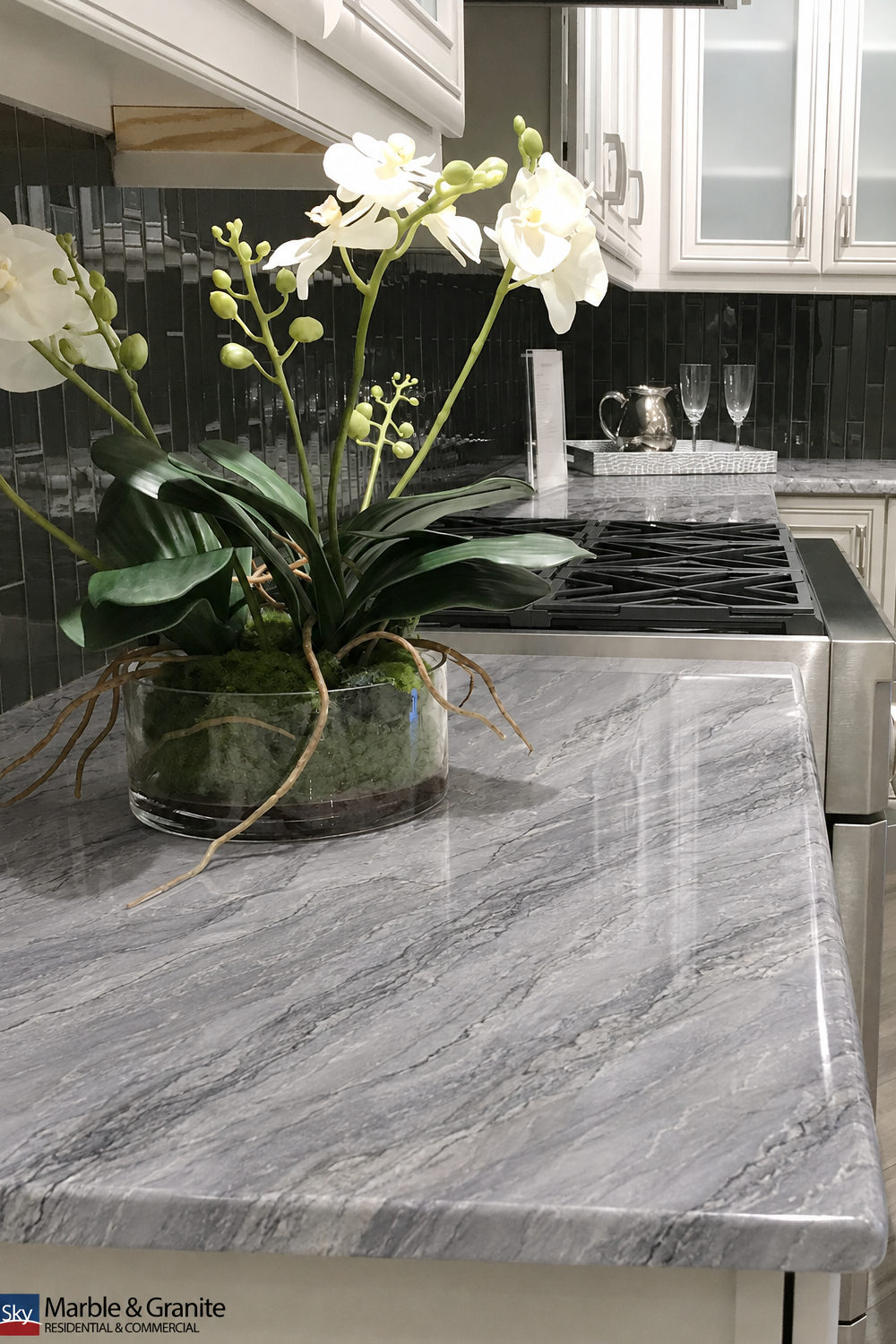
Smoky Textured Quartzite
Quartzite Countertops | ID# 26050738
Smoky Textured Quartzite Countertops in Bright Modern Kitchen
Soft grey movement with a low-sheen surface. Textured finishes tend to hide fingerprints better than high polish.
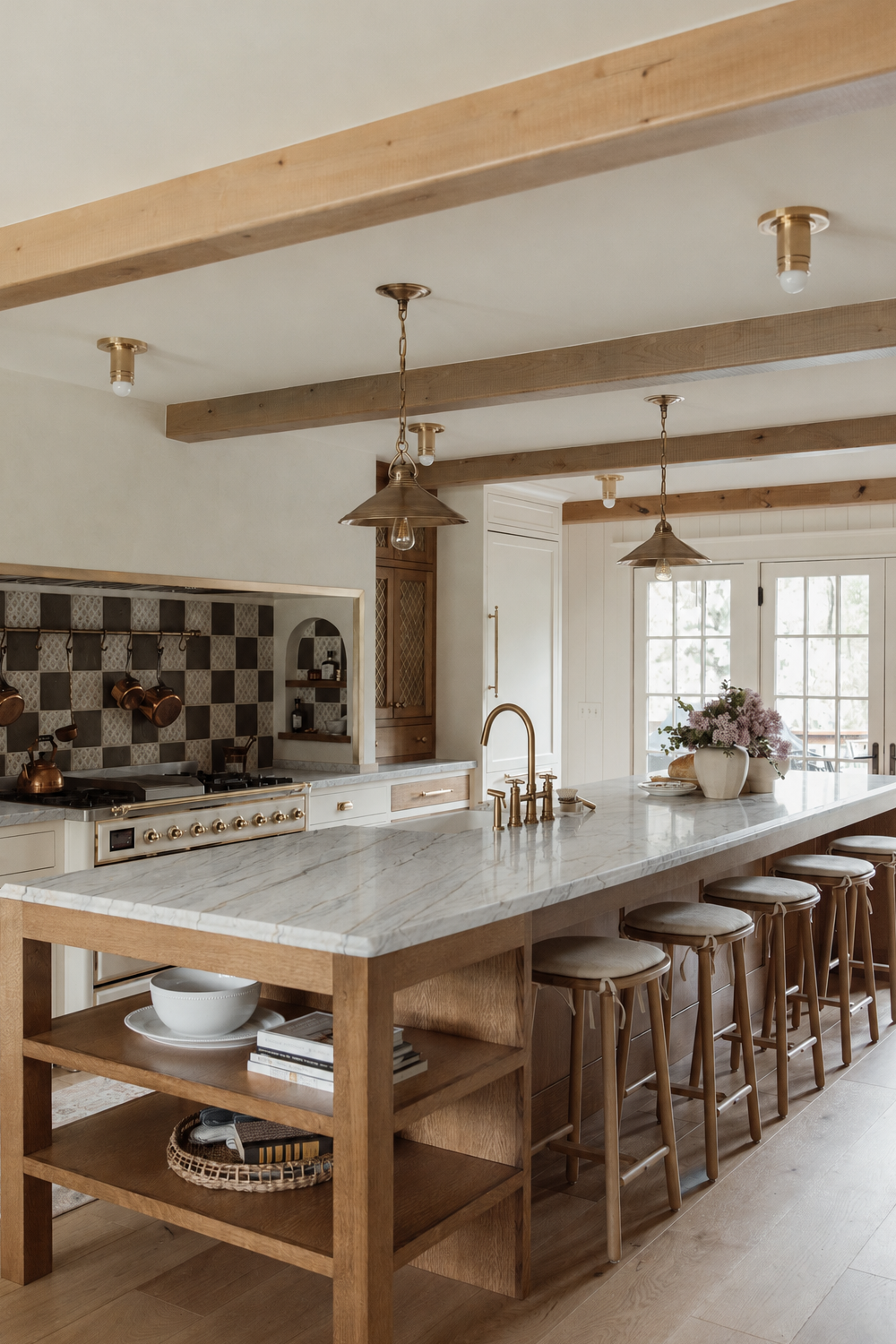
Zermatt Quartzite Polished
Quartzite Countertops | ID# 26050727
Zermatt Quartzite Polished Quartzite Long Island Countertop
Gentle grey veining on a warm white base — softer patterns tend to hold together across a long run.
Where Quartzite Tends to Make Sense
Homeowners often lean toward quartzite when they want real depth and variation — a surface that reads differently in morning light than under evening pendants. It stands up well to knives and daily wear, and it’s naturally heat-tolerant, which matters in kitchens that see serious cooking.
The trade-off worth knowing upfront: quartzite is porous, and most slabs benefit from sealing roughly once a year. It’s a straightforward job, but it is a recurring one.
Two other practical notes. Quartzite is hard enough that it’s slower and harder on tooling to cut, which is generally reflected in fabrication cost — a factor worth considering to avoid committing from just the slab price until you get the full quote accounting for that cost. And because slabs vary, the number available from a single block is finite. If a kitchen needs three slabs from the same lot, that’s a conversation to have while the stone is still on the floor, not after templating.
It’s also worth asking how a given slab has been finished. Polished brings out depth and color at the cost of showing water spots; honed and leathered surfaces read softer and hide more, though they can absorb slightly more readily. Neither is better — they suit different households.
What Quartz Offers Differently From Quartzite
Quartz takes a different approach. Because the pattern is designed rather than quarried, what you see in the sample is very close to what arrives at your home.
That predictability matters more than people expect. On a long run of counters, a full-height backsplash, or matching surfaces across a kitchen and two baths, consistency between slabs is often the difference between a result that looks composed and one that looks slightly off. Quartz is also non-porous — no sealing, and strong resistance to staining from wine, coffee, oil, or citrus.
Our Luxury Quartz Collection
From the bold veining of Calacatta Gold to the soft neutrals of Desert Silver — Silestone surfaces with the look of natural marble and virtually no upkeep.
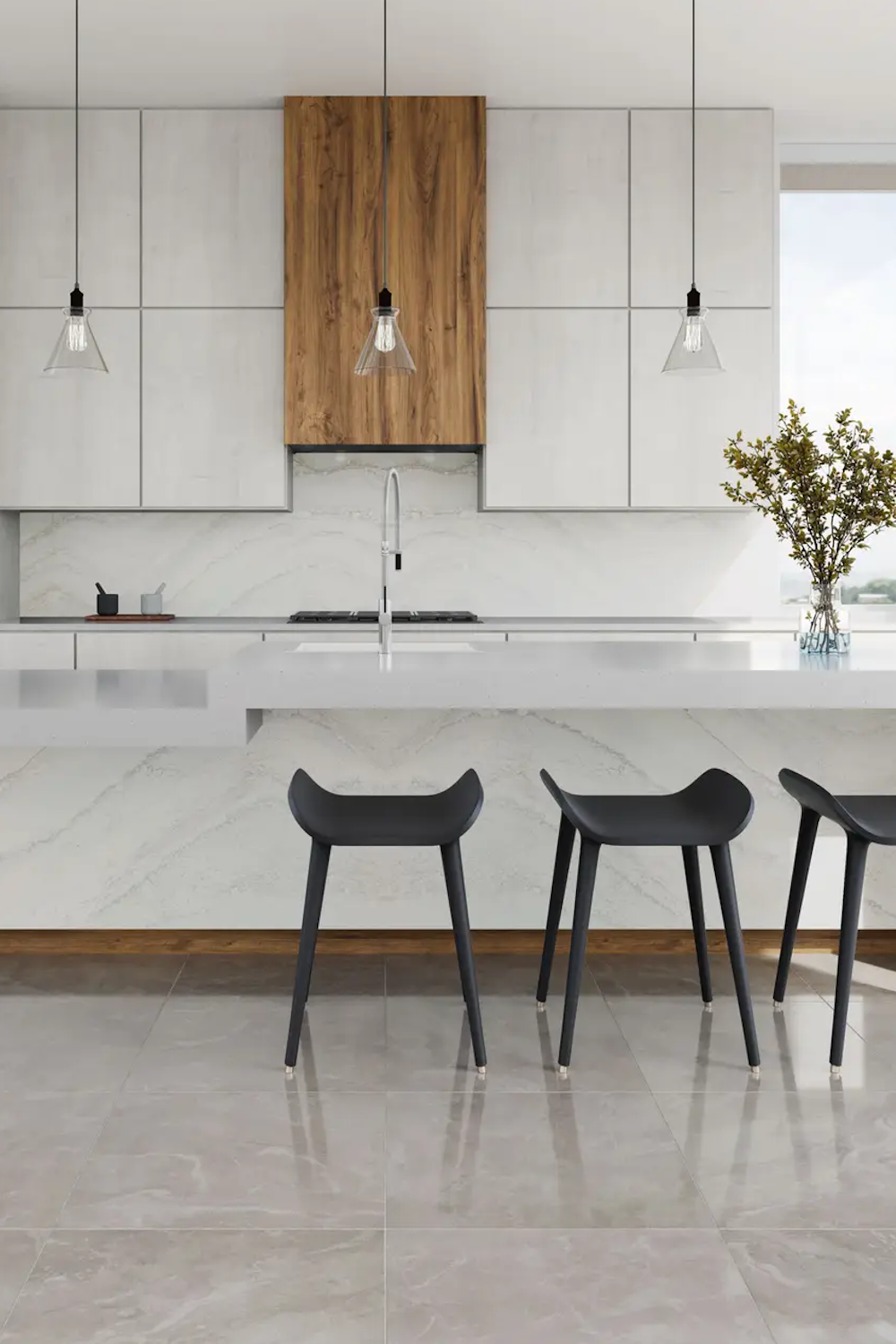
Everleigh Quartz
Quartz Countertops | ID# 26050740
Everleigh Quartz Kitchen Backsplash
Soft, wide grey movement on a bright field. Consistency lets counter, waterfall, and backsplash read as one surface.
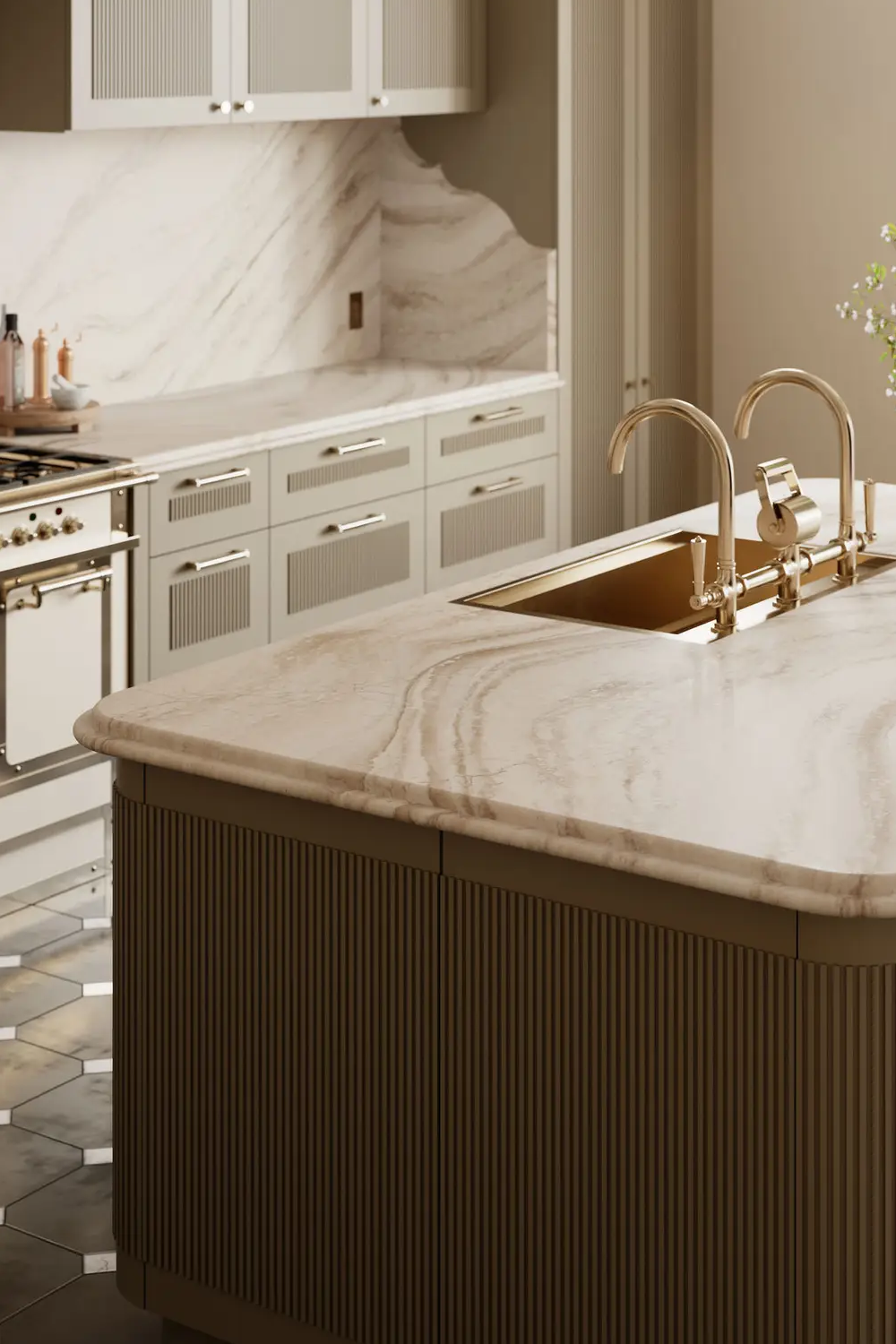
Everleigh Warm Quartz
Quartz Countertops | ID# 26050741
Everleigh Warm Quartz Kitchen Island Countertop
The same movement in a warmer register — sand and honey rather than grey. Suits cream, brass, and softer woods.
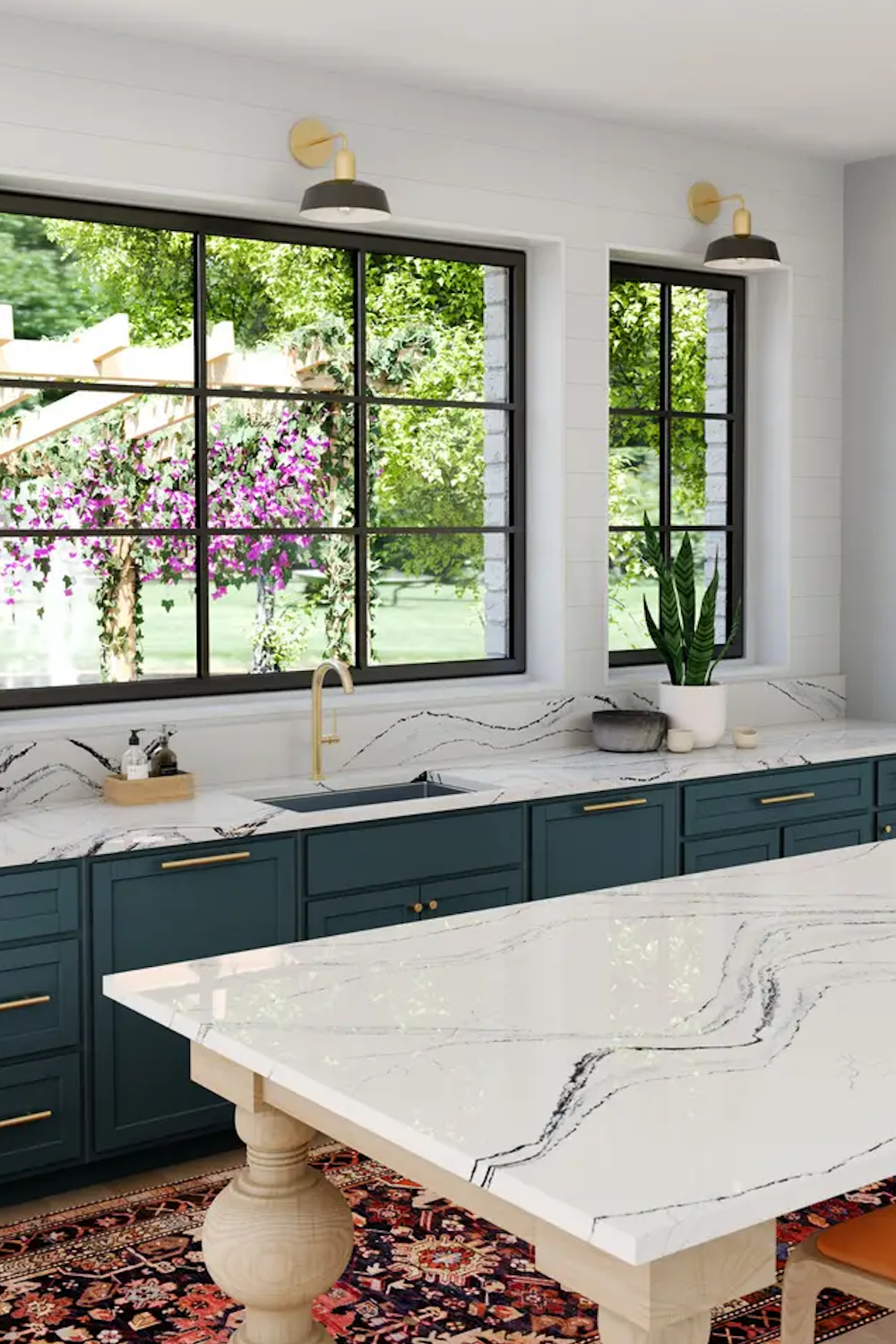
Portrush Quartz
Quartz Countertops | ID# 26050743
Portrush Quartz Veined Kitchen Island & Countertops
Crisp white cut by bold, graphic black veins. It holds its own against saturated cabinet color.
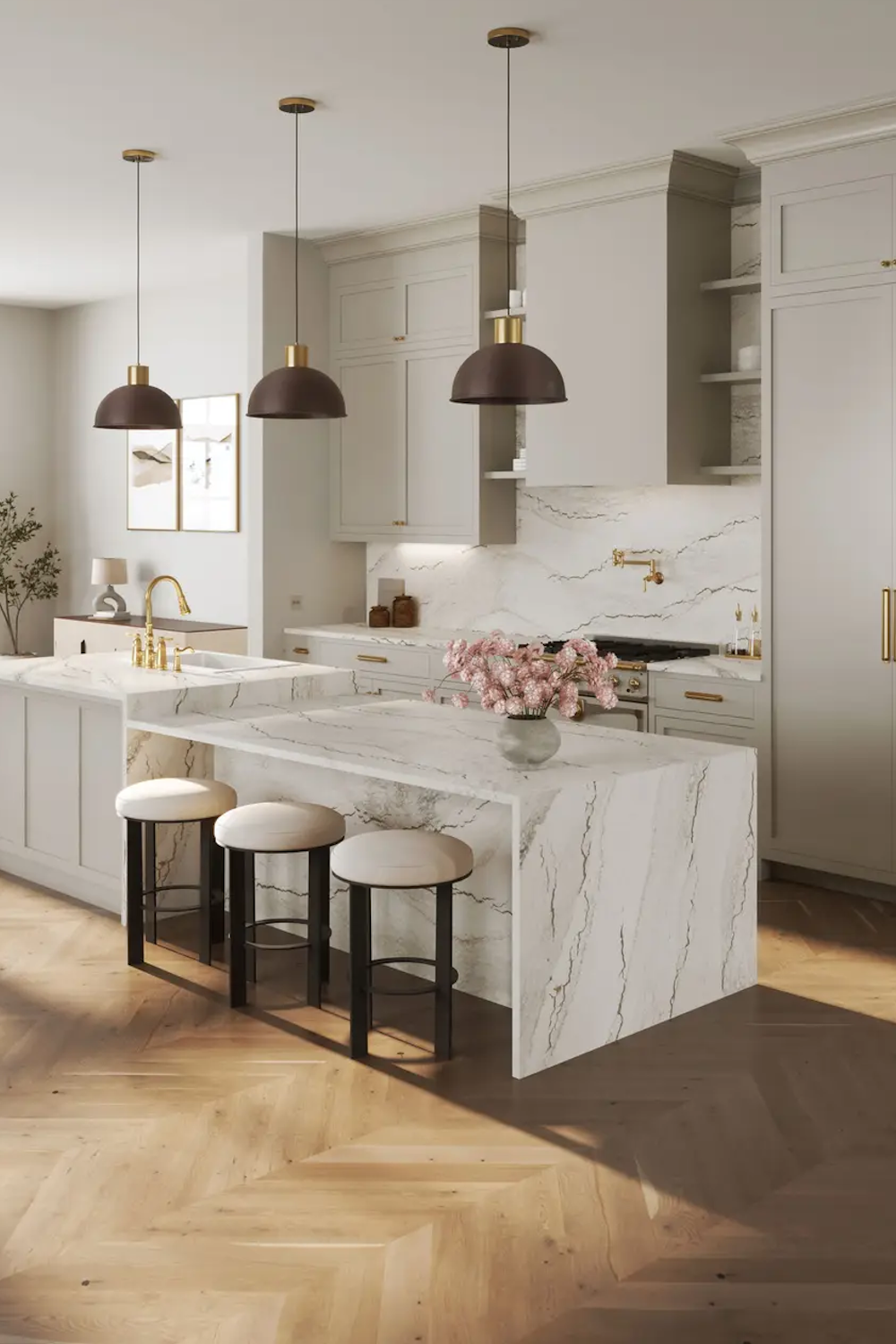
Inverness Blakeley Quartz
Quartz Countertops | ID# 26050744
Inverness Blakeley Quartz Waterfall Island
Fine, marble-like veining with a warm undertone. Natural-stone looks with predictable seams and no sealing.
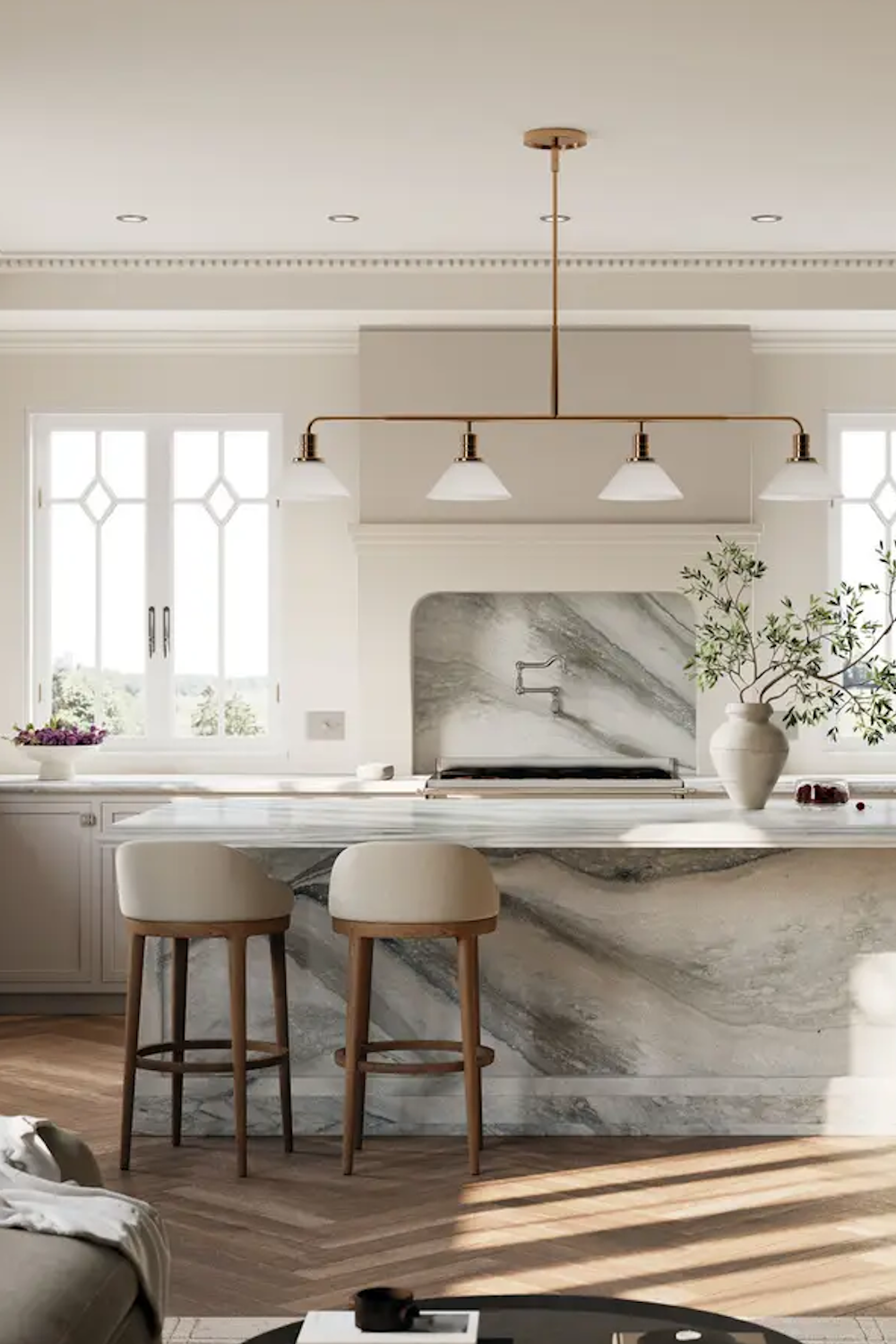
St Isley Quartz
Quartz Countertops | ID# 26050745
St Isley Quartz Kitchen Island
Broad grey-blue movement with a hand-painted quality — engineered surfaces aren’t limited to quiet patterns.
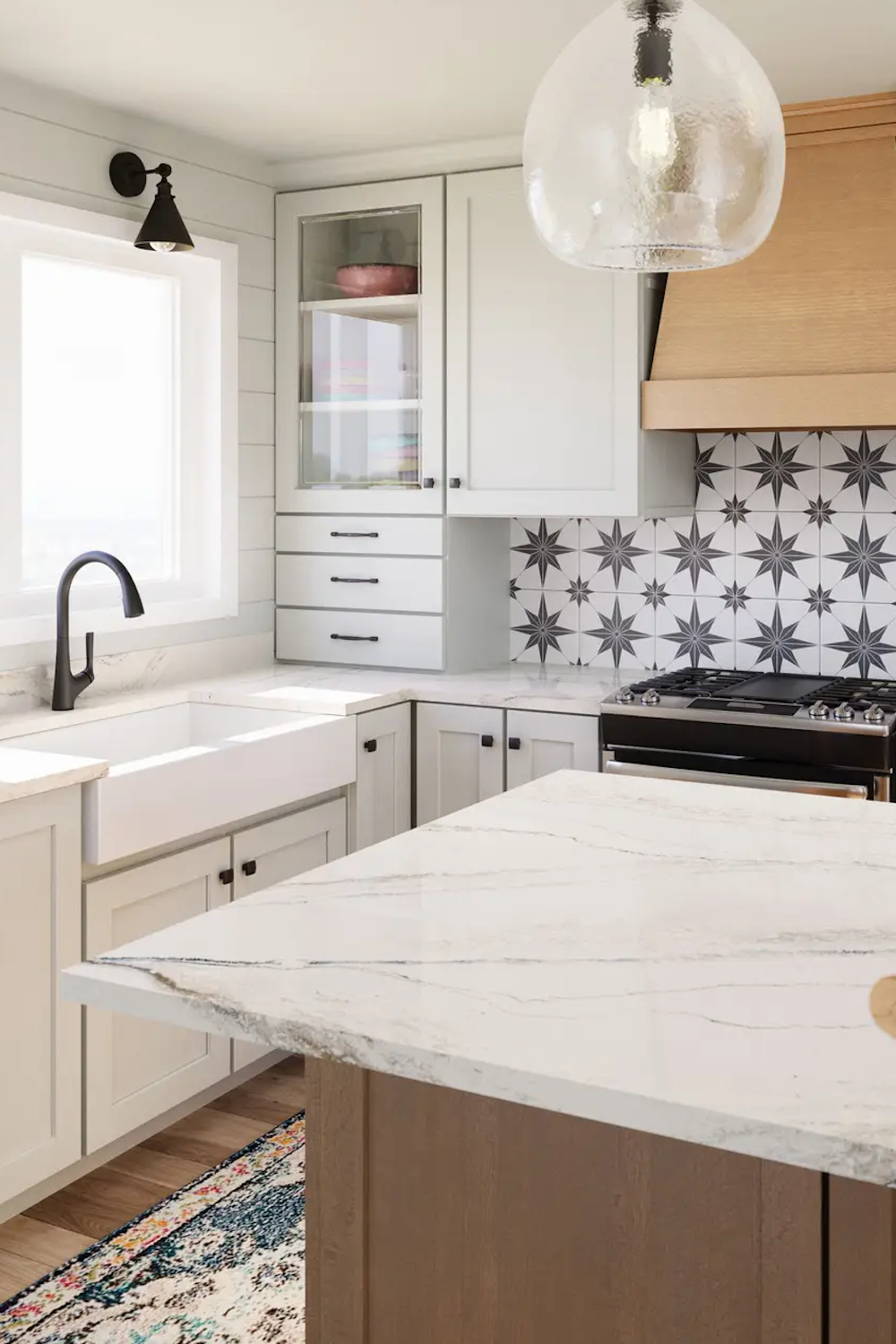
Lakedale Quartz
Quartz Countertops | ID# 26050746
Lakedale Quartz Kitchen Island Countertop
Delicate linear veining on a warm white base. Understated enough to sit beside a patterned backsplash.
Not Every Quartz Imitates Marble
Veined patterns get most of the attention, but engineered surfaces can go places natural stone generally can’t — concrete-like textures, saturated color, finishes built around depth rather than movement.
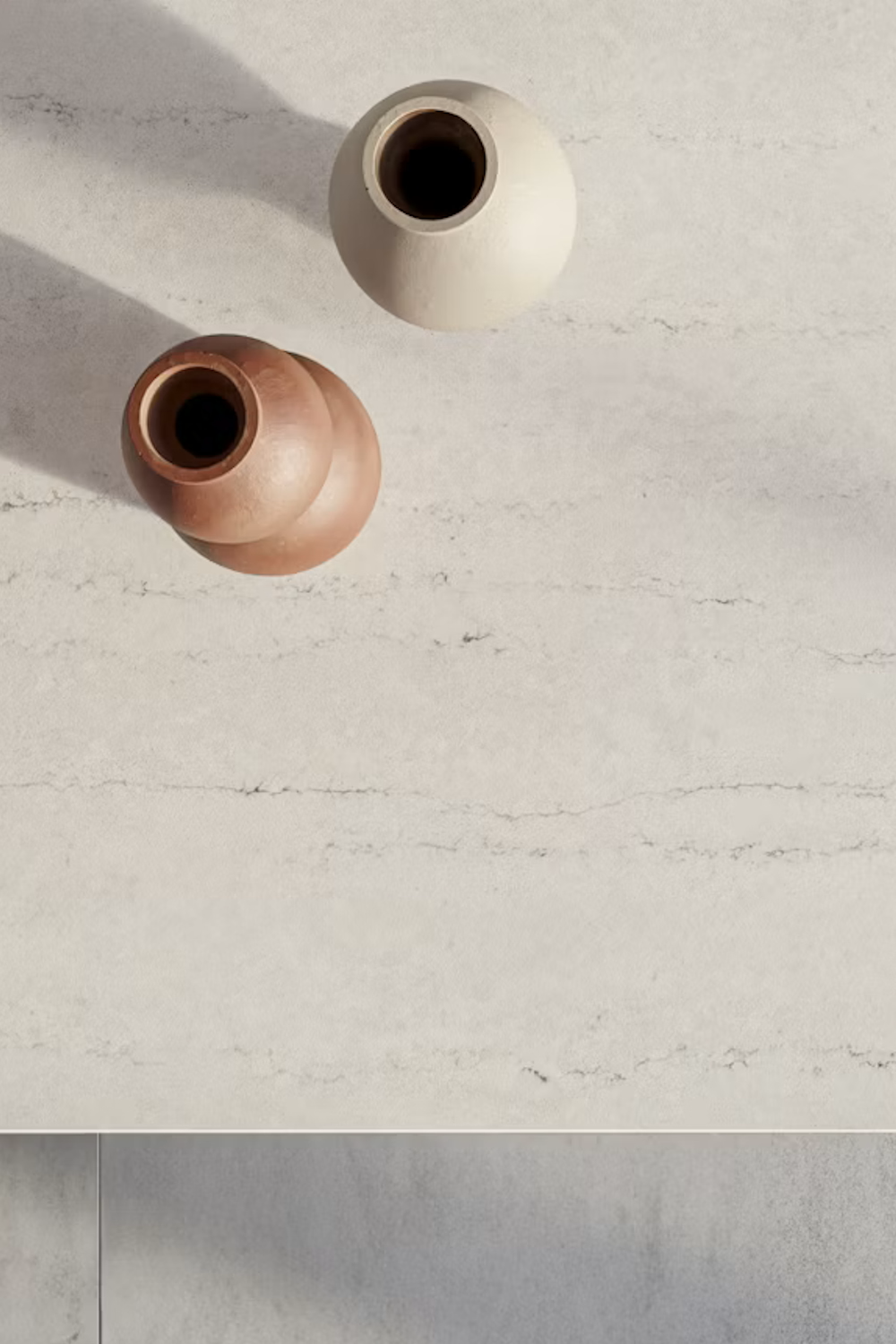
Raw A Quartz
Quartz Countertops | ID# 26050747
Raw A Quartz Countertop
A pale concrete-like field with faint horizontal striations. Suited to minimal spaces.
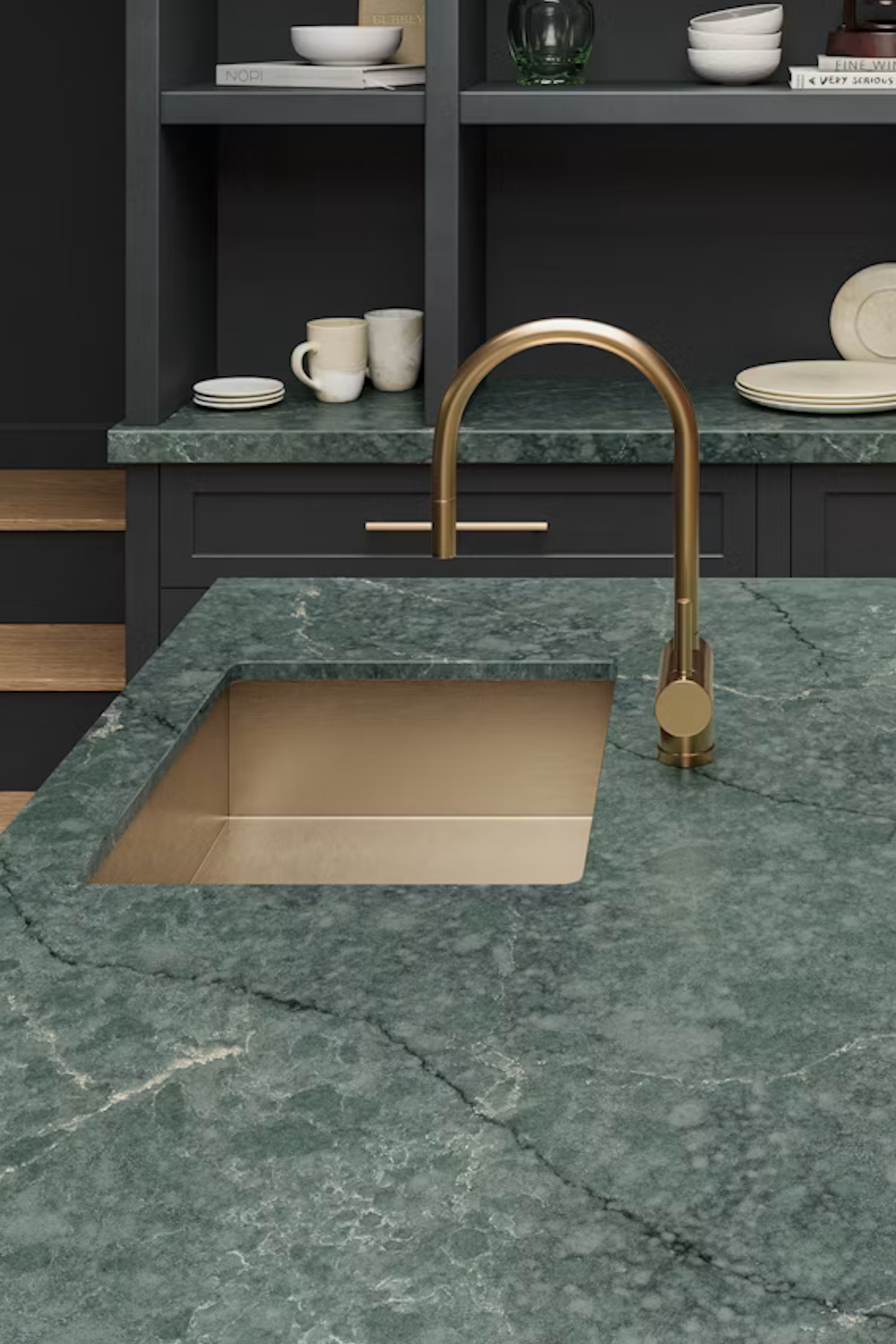
Jardin Emerald Quartz
Quartz Countertops | ID# 26050748
Jardin Emerald Quartz Kitchen Countertops
Deep green with pale mineral veining. Color this saturated is hard to source consistently in natural stone.
Darker Quartz Is Worth a Look
Light surfaces dominate most kitchen photography, but a darker counter can do things a white one can’t — ground a room, add contrast against pale cabinetry, or hide daily use more gracefully.
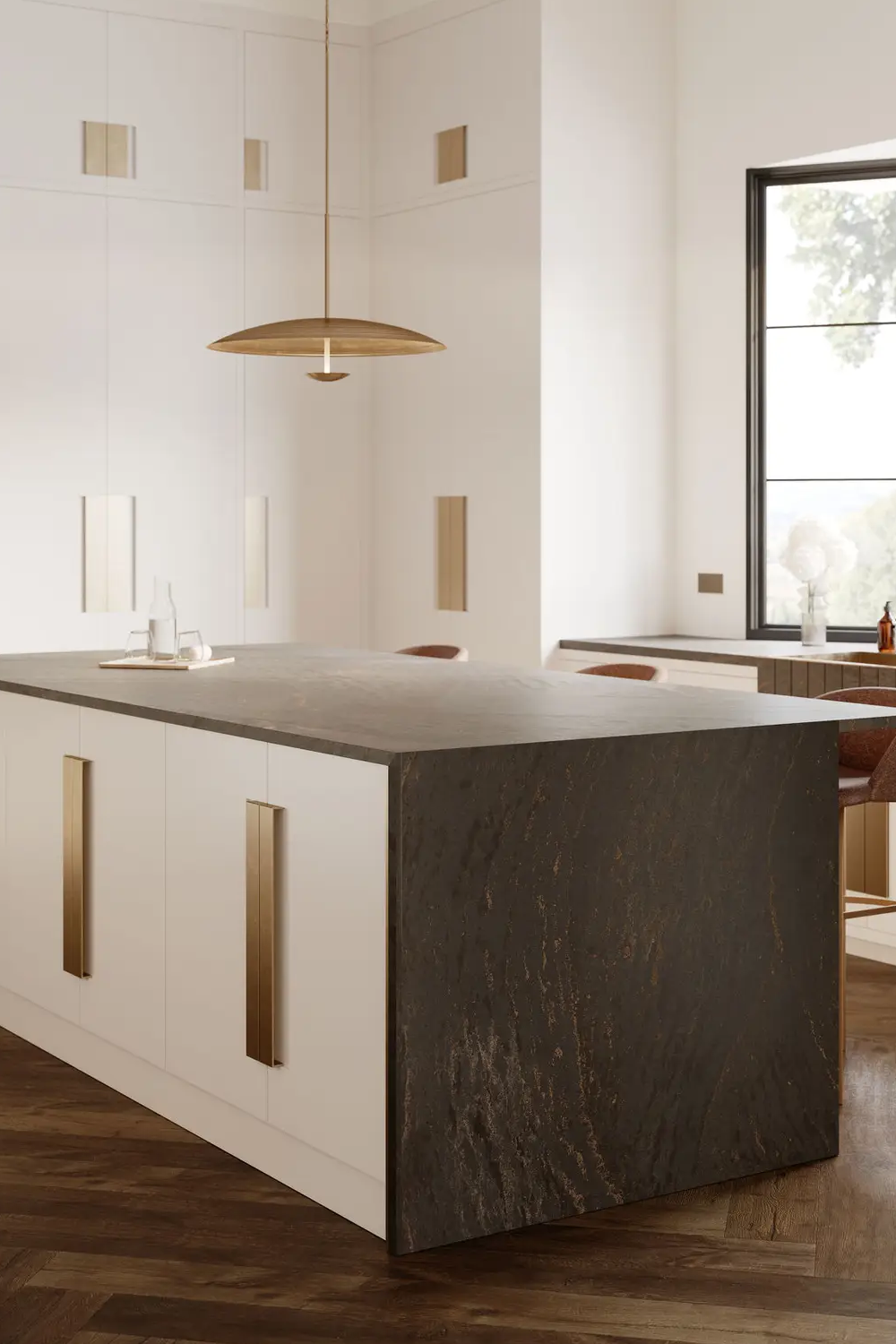
Remington Brass Quartz
Quartz Countertops | ID# 26050749
Remington Brass Quartz Waterfall Island
Deep bronze-brown with visible mineral texture. Worth a look when a kitchen needs weight rather than another light surface.
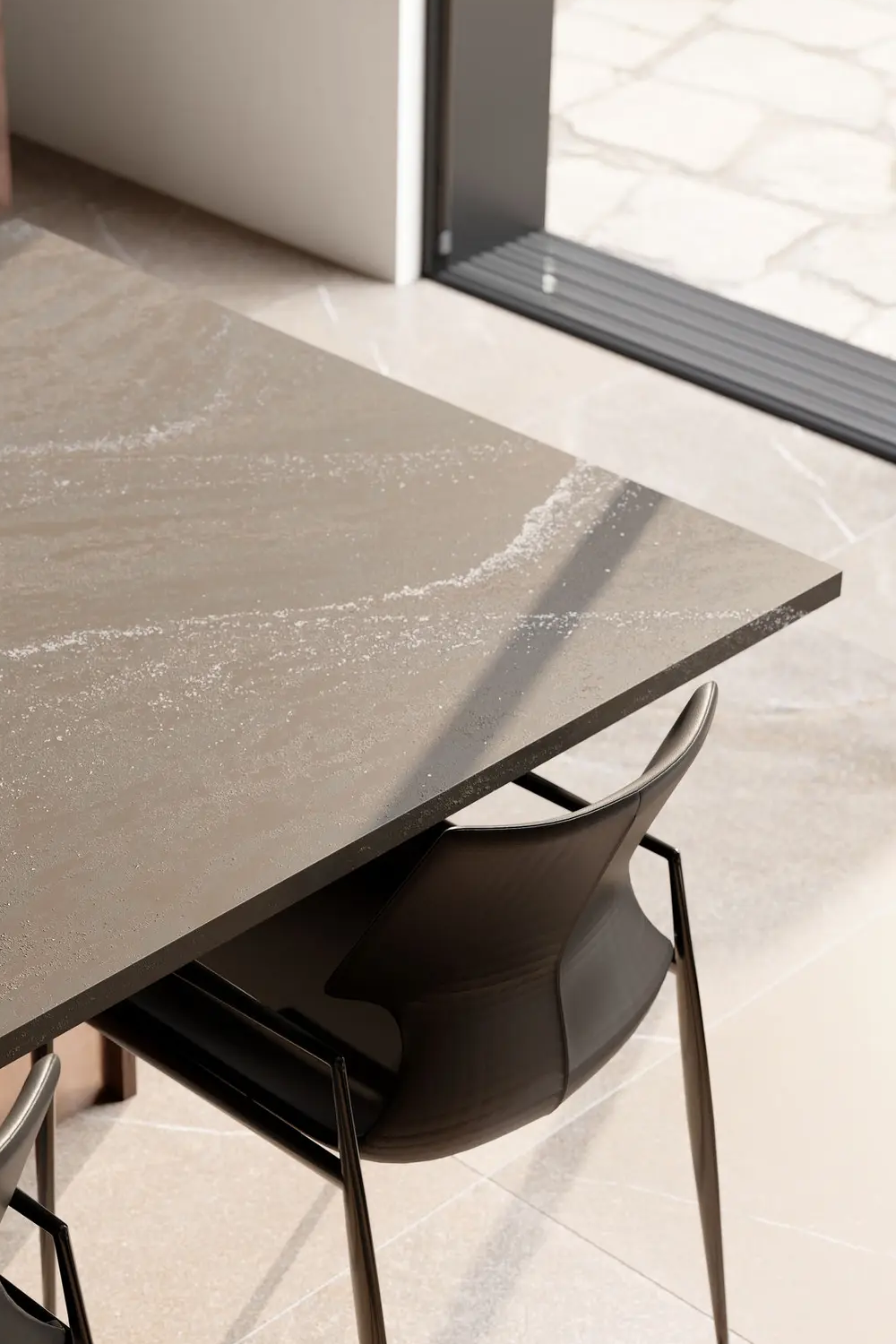
Remington Steel Quartz
Quartz Countertops | ID# 26050751
Remington Steel Quartz Kitchen Table
A softer, greyer take on the same texture — closer to weathered concrete. Good for contemporary spaces.
GET A FREE ESTIMATE TODAY
Living With Quartz
Because quartz contains resin, it’s more sensitive to direct heat than natural stone. A trivet under anything coming off the range or out of the oven handles it entirely — but it’s a habit worth building deliberately to avoid any undesired accidents over time.
Day-to-day care is otherwise minimal: warm water and mild soap. It’s best to avoid abrasive pads and harsh solvents, which can dull the finish over time, and prolonged direct sun can gradually affect some pigments, which is worth mentioning if a run of counter sits under a large south-facing window.
One detail that gets overlooked at the design stage is seam placement. Because quartz patterns are printed to a repeat, a seam through a bold vein is more visible than a seam through a quiet field. Discussing seam locations before fabrication — rather than after — usually produces a better result on large islands.
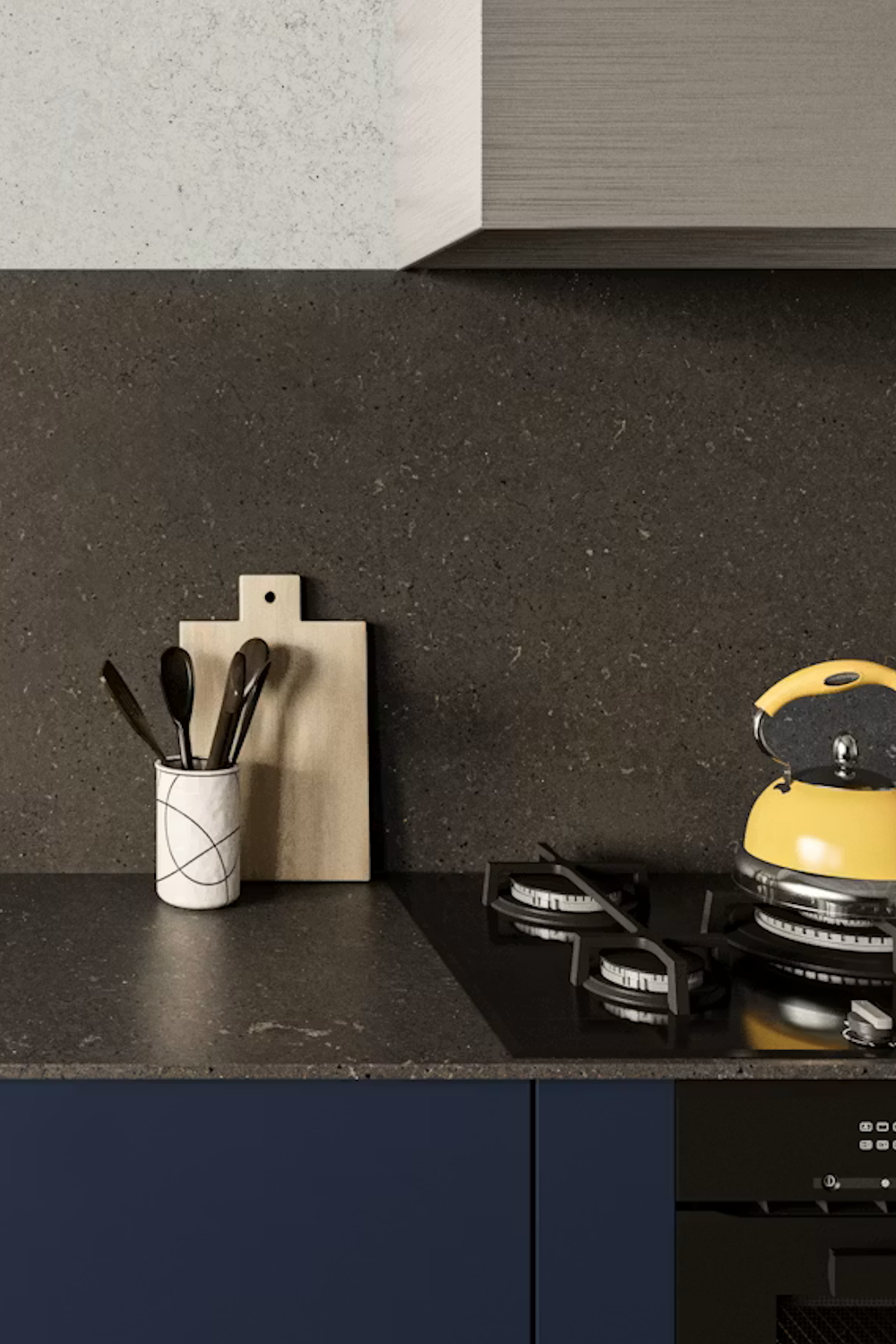
Brass Relish Quartz
Quartz Countertops | ID# 26050752
Brass Relish Quartz Kitchen Countertop
Deep espresso-brown with fine mineral speckle. Against navy cabinetry it reads warm rather than heavy.
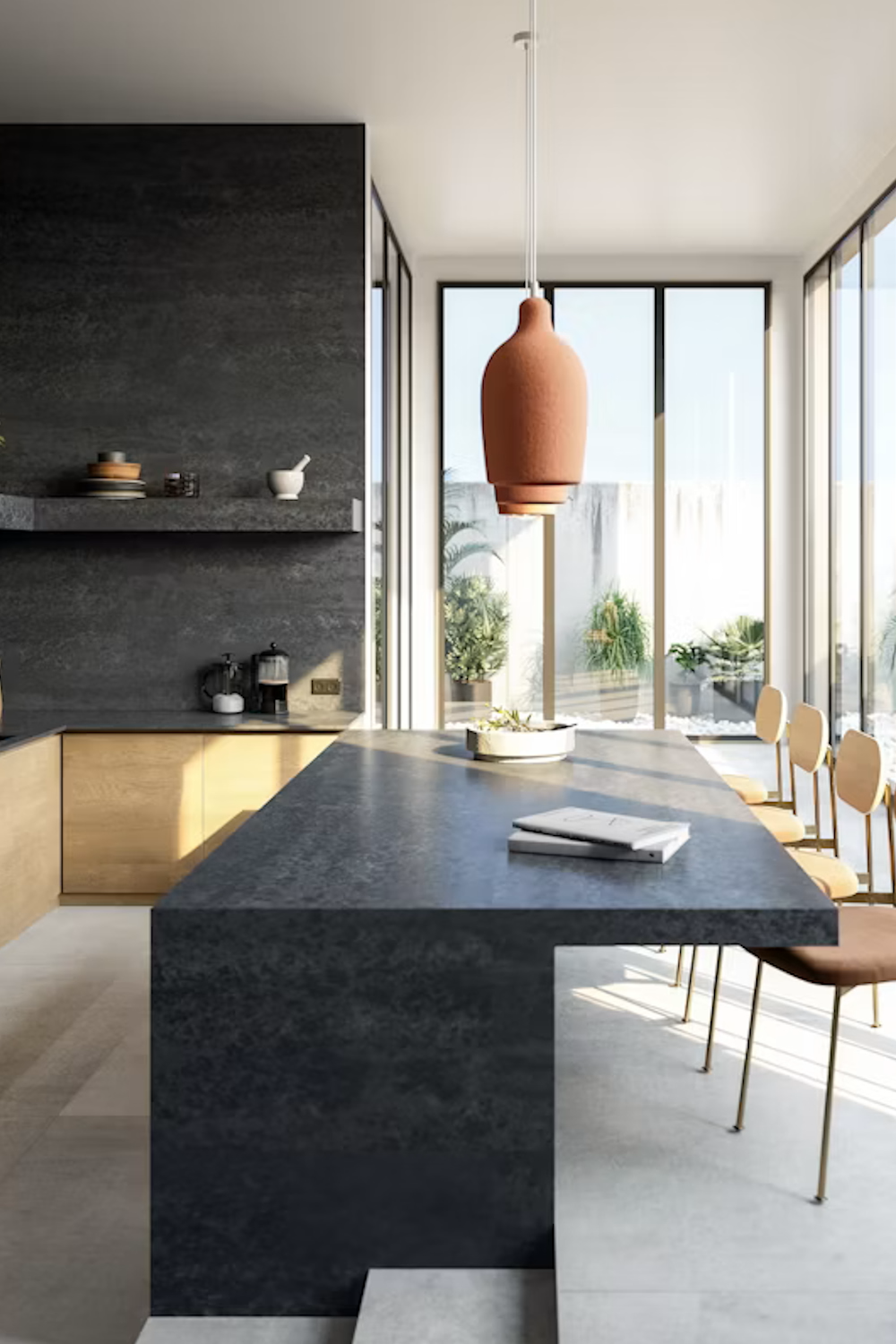
Raw D Quartz
Quartz Countertops | ID# 26050753
Raw D Modern Kitchen Island
Near-black with slate-like depth. Across an island and adjacent wall it does real architectural work.
How the Two Compare, Side by Side
Origin
Pattern
Sealing
Heat
Stains
Selection
Best suited to
Quartzite
Natural stone, quarried
Unique to each slab
Generally once a year
Naturally tolerant
Resistant while sealed
Choose your actual slab
Statement surfaces, heavy cooking
Quartz
Engineered: quartz, resin, pigment
Consistent, designed
Not required
Use a trivet
Highly resistant
Choose from samples
Long runs, multi-room projects
A Few Questions Worth Asking Yourself
- How much variation do you want? If the idea of a one-of-a-kind slab appeals, quartzite is likely the more satisfying path. If surprises at installation would bother you, quartz offers more predictability.
- How do you cook? Heavy, hot-pan cooking may point toward quartzite. Busy, spill-prone households often gravitate to quartz.
- Is annual sealing realistic for you? For some people it’s a non-issue. For others it’s the deciding factor, and there’s no wrong answer.
- How large is the installation? Long runs and multi-room projects tend to favor the consistency of engineered surfaces.
- Where will it live? A dramatic natural slab may be perfect on a single island and overwhelming across an entire kitchen.
There’s rarely a wrong answer here. Both materials perform well in high-end kitchens and baths, and both will outlast most of the other finishes in the room. It’s more a question of which set of trade-offs suits the way you live.
See Them Side by Side
Photographs can only tell you so much. Veining scale, translucence, and the way a polished surface behaves under your own lighting really need to be seen in person — ideally with a cabinet sample in hand.
Schedule a private slab viewing or request an itemized, no-hidden-fee estimate today. We’d be glad to walk you through both materials and help you narrow it down at your own pace.
Quartz vs. Quartzite: FAQ
Is quartzite the same as quartz?
No. Quartzite is a natural stone formed from sandstone under heat and pressure. Quartz countertops are engineered from crushed quartz mixed with resins and pigments.
Which is more durable, quartz or quartzite?
Both are very durable. Quartzite generally handles heat better because it contains no resin. Quartz is nonporous and resists staining without sealing.
Does quartzite need to be sealed?
Most quartzite benefits from sealing because it is a natural stone and can be somewhat porous. How often depends on the specific slab; your fabricator can recommend a schedule.
Is quartzite more expensive than quartz?
Quartzite is often priced higher, especially for exotic slabs, but prices overlap. The specific slab, size, edge details, and installation determine the final cost.


WHAT PEOPLE HAVE TO SAY ABOUT US!
We appreciate your time and effort in sharing your experience with us